
Good Shepherd Sermons & Blogs
We have the privilege, for a remarkably short time, of experiencing a remarkably tiny piece of God’s creation.
2026-49
sermon preached at Church of the Good Shepherd, Federal Way, WA
www.goodshepherdfw.org
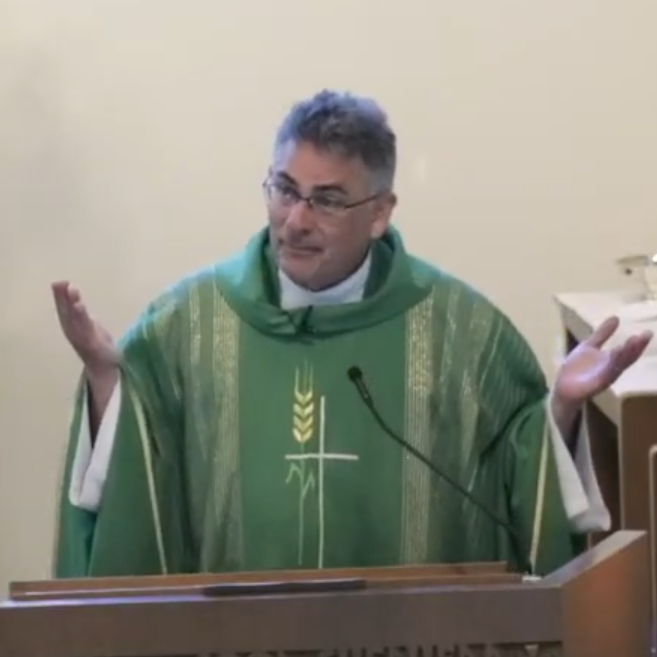
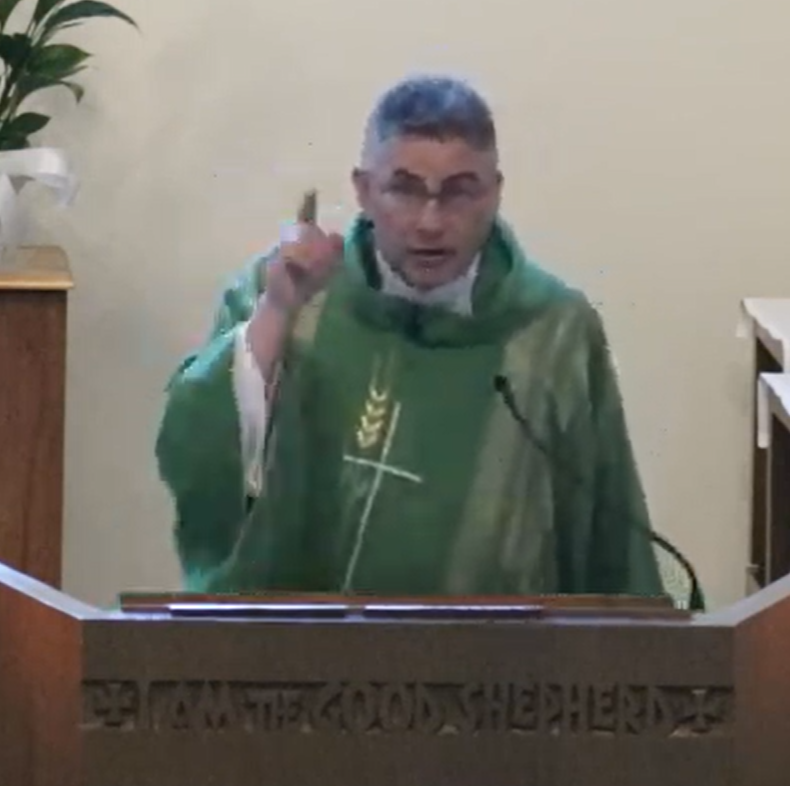
by the Rev. Josh Hosler, Rector
The Feast of Creation in Christ (Year A), September 6, 2026
Genesis 2:4-25; Psalm 148:1-14; Acts 17:22a-24-28; John 1:1-5
I will begin and end today with poetry, because I must. First, a very brief poem by one Hallie Bateman, which I came across in the book How to Do Nothing by Jenny Odell:
We’re all here together, and WE DON’T KNOW WHY.
I have a quirky memory from my senior year in high school. I was leaving a movie theater with some friends on a winter night. As we were getting back into the car, I saw an apple core lying in the snow: evidence of human activity.
I stuck out my foot and kicked the apple core away. And I thought, “I just affected God’s creation by kicking that apple core. I changed the world. How often do we really pay attention to the effect we have?” It was so insignificant. We all do such things every day. But it demonstrates that our mere existence grants us the ability and the right to change existence!
We could do worse than to wake up every morning and ponder such things. Because the ways we change the world are not just functional. They are poetic and spiritual.
Today we celebrate the Feast of Creation in Christ; you’ll find an explanation on page 3 of your service leaflet. And we just heard the second creation story in Genesis, which is markedly different from the first. Interestingly, this second story is probably far older than the seven-day story of creation we hear in church more often. The two stories cannot be reconciled as if they were journalistic accounts: that’s not their purpose. They are theological poetry.
You may remember that the creation story in Genesis 1 begins with an overabundance of water that God must push aside to make space for creation. The story comes from the time of the Babylonian exile, as the Israelites languished in captivity on the fertile flood plain between the Tigris and the Euphrates.
The story in Genesis 2, however, comes from long before the exile. Its origin in the Holy Land itself reflects the reality of frequent drought and famine. The natural state there is waterlessness, which requires God to intervene with rains and rising streams. The setting of the story, however, is also “in the east,” at the origin of the Tigris and the Euphrates. A literal Eden would have to be far to the northeast of Israel in the mountains of Eastern Turkey, from which these two mighty rivers flow through Syria before arriving in present-day Iraq, formerly the seat of the Babylonian Empire.
From a state of waterlessness, God forms a human being—in Hebrew, adam—from the dust—in Hebrew, adamah. Do you hear the poetry there? Adam comes out of adamah. God then breathes life into the creature. Note that despite the he/him pronouns in our translation, we’re not talking about a man anatomically—that would be the Hebrew word ish. The word adam is the generic word for a human being. So we can imagine instead a single, sexless creature; only later in the passage does sexuality come into existence.
Next we come upon a rhapsody of praise for God’s creation. The trees are growing, and two specific trees will go on to play an important role in the human story. Four rivers are mentioned—the Tigris and Euphrates, but also the Pishon and Gihon, which have never been identified directly with any real-life rivers. However, there are hints that they belong in Africa, so there’s no point trying to make them geographically literal.
God recognizes the need for the human not to be alone, so God creates all the animals of the world. Adam gets to name the animals in a charming fable—a trial-and-error sequence in which no worthy partner is found for the human. The human creature is of a different order (and species!) and will need God to go back to the woodshed on this project.
Throughout this passage we find multiple examples of what we call etiology: a story created to explain why things are the way they are. At the risk of pressing my point too much, to insist on taking an etiology literally is to suck all the power out of it. The truth within an etiology lies in its poetry and in the way that poetry is situated within a broader culture. So, then, why is it that humans tend to pair off as men and women and get married? Here’s a story: the woman was made from the man’s rib—or, to put it another way, God split the single creature into two complementary ones who could be partners to each other. Now we have both man and woman—in Hebrew, ish and ishah.
Remember that these stories are culturally situated poetry. Human coupling does not happen only between men and women. Ancient Jews would not have accepted any other possibility as normative, but in our day we can deduce from experience that same-sex partnerships also bless the world. Furthermore, we are gradually coming to understand that sex and gender are two related but different phenomena that are more cultural than biological.
So while the story speaks of man and woman, I hear in it that all humans need companionship, sexual or otherwise. It’s poetry, and that means we get to keep playing with it. As we humans continue to learn about creation and continue to change it, our sacred stories demonstrate their worth by stretching and adapting.
Take, for example, the world of astronomy. Perhaps it never occurred to the ancients that there are whole swaths of God’s creation that we humans will never see or experience. Look at the latest photos from Mars, or those incredible shots of Pluto from a few years ago. We were the first living beings ever to see these things. But they have been there for billions of years, unwitnessed until now. Some people take this as evidence for the lack of a creator, but to me it speaks precisely the opposite. What a privilege it is to witness any part of this creation! It is somehow divine to be able to do that. The holy solemnity and wonder of it all has been given to us as a gift. As living beings, we have the privilege, for a remarkably short time, of experiencing a remarkably tiny piece of God’s creation.
Such thoughts fill me with awe and humility. They remind me that anything we ever say about God is not purely obvious or descriptive, but aspirational. It’s either what God might be like based on the evidence of our senses in creation, or what we hope God is like. Perhaps it’s what we need God to be like if we’re going to keep seeking relationship with our creator.
And so we come to the question of the specific ways that we humans are changing our little slice of God’s creation—the ways we prioritize certain things over other things. We need both trees and houses, but we chop down trees so we can build houses. We kill animals and eat them, though we would never want to be cruel to animals. We build gigantic data centers that pollute rural communities, because it’s helpful just to ask the computer to do that difficult task for us. We take a job that requires us to be cruel to others, and we justify it because we need to feed our families. As we humans encounter ethical dilemmas and must resolve them, we all compromise our principles to some degree. Many of us even kill each other, and we develop complicated ethical codes to justify it. When we do so, are we numbing ourselves to the wonder of living?
The Bible is one people’s story of the miracle of human life. The Bible chronicles an ancient people’s attempts to live and thrive—to change God’s creation for the better. We, too, in our own day, keep changing the world. Are we changing it for the better? Are you changing it for the better? What do you think?
Hear the news from the United Nations this week: the world will absolutely warm beyond the 1.5 degrees Celsius that we had hoped to stay below. According to the story from PBS: “U.N. officials recommend trying to limit excessive warming and then bring the temperature back down to the agreed-upon threshold. But it still will mean decades of increased weather-related disasters, rising seas, extinctions and melting ice and glaciers.” There will be many more disasters like the catastrophic, deadly flooding in Nepal and China, because this is one way that we human beings have changed God’s creation. I need to allow for the possibility that climate change will eventually be at least an indirect cause of my own inevitable death.
Why doesn’t God prevent us from acting like this? Why does God grant us absolute freedom over our environment? Is there a plan to save us?
And so we find that we tell stories not of a creator we can clearly demonstrate, but of a creator we need to believe in. We cling to this seemingly frail hope: that despite all the random chance and violence and cruelty and pain, everything we’ve ever experienced is being held in the divine, loving hands of the one who loves us so much that he emptied himself of divine power and came to be with us. We Christians keep coming back to our distinct proclamation:
In the beginning was the Word, and the Word was with God, and the Word was God. The Word [—Christ, the Messiah, the one we met as Jesus of Nazareth]—was in the beginning with God. All things came into being through him, and without him not one thing that exists came into being. In him was life, and the life was the light of all people. The light shines in the darkness, and the darkness did not [—has not—will never] overcome it!
Christians choose to believe that all of this began somewhere holy and is going somewhere hopeful. So we play out our brief time on the stage, and no matter how long or short our lives, perhaps it is enough. Perhaps we are indeed helping Christ love the world back into wholeness.
Last week Anna paid tribute to Dolly Parton, and now it’s my turn to honor a present-day saint on the occasion of their death. That person is the poet and environmental activist Wendell Berry, who died last Monday. In 1973 Wendell Berry wrote a poem called “Manifesto: The Mad Farmer Liberation Front.” I want to finish today with the closing stanza of that poem.
Go with your love to the fields.
Lie down in the shade. Rest your head
in her lap. Swear allegiance
to what is nighest your thoughts.
As soon as the generals and the politicos
can predict the motions of your mind,
lose it. Leave it as a sign
to mark the false trail, the way
you didn’t go. Be like the fox
who makes more tracks than necessary,
some in the wrong direction.
Practice resurrection.