
Good Shepherd Sermons & Blogs
What will you do about the things you don’t yet understand?
2026-17
sermon preached at Church of the Good Shepherd, Federal Way, WA
www.goodshepherdfw.org
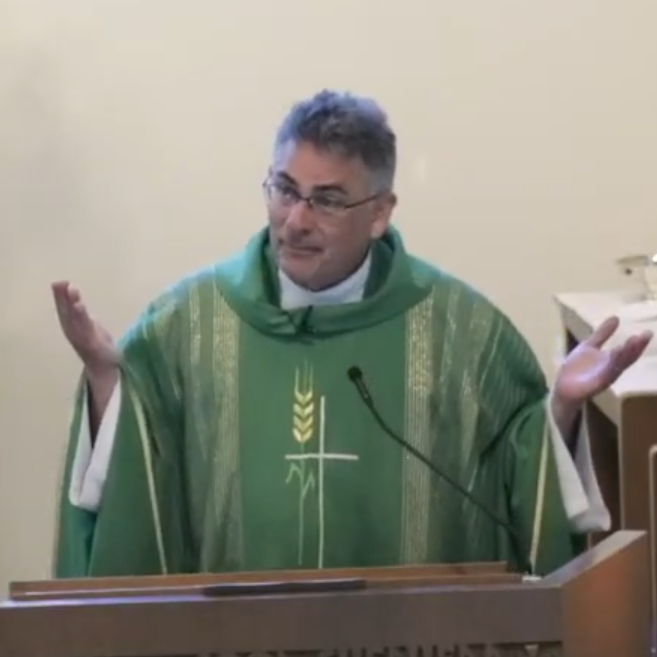
by the Rev. Josh Hosler, Rector
The Second Sunday in Lent, March 1, 2026
Genesis 12:1-4a ; Psalm 121 ; Romans 4:1-5, 13-17 ; John 3:1-17
My spiritual director’s refrigerator is plastered with little nuggets of wisdom on magnets. My favorite one is this: “When life throws you a crisis, just shout, ‘Plot twist!’”
This wisdom came to my aid a few weeks ago when our child Sarah, currently studying in Namibia, found out that the geology classes she’d hoped to take are only offered at the other campus, 500 kilometers away. “Plot twist!”
Well, after some stressful conversations with professors and administrators, Sarah now gets to do an independent study of Namibian geology and take some other classes she wouldn’t have thought to take, and the university is working with her to make sure she still gets to graduate next year. What seemed at first like a tragedy has become a unique opportunity. But that couldn’t have happened without Sarah—and Christy and me—first processing our fears, distancing ourselves from our anger, and then getting curious about what might become possible.
So now put yourself in the shoes of Abram and Sarai. They’ve lived good long lives, but not entirely without regret: they were never able to have children. Now very old, they figure it’s about time to sleep with their ancestors. But no—here comes a new call from an unexpected deity: “Time to pack up and leave for a new country. We’re just getting started, and your descendants will be numbered as the stars in the sky, and your family will be a blessing to everyone on earth.”
“Plot twist!”
God changes their names from Abram and Sarai to Abraham and Sarah. They will never be able to go back to the way things were before.
You know, I think the main reason I became a priest is that I recognized that I would never lose my thirst for the knowledge of God—nor would I ever want to! I want to keep drinking from the deep, deep well of divinity that I encounter all over God’s world, and I want to keep helping other people do the same! I see God in places of comfort and joy, but also in places of desolation and despair. In other words, I see God in every plot twist, if not in the moment, then at least with hindsight—and always bringing more love.
But my thirst for the knowledge of God would never have developed if I hadn’t gotten curious first. My parents put me in places that encouraged my curiosity. My home life and the churches of my childhood were places where questions were always encouraged. Hypothetical answers were to be tested, not assumed. There was ample space and time in which I could have a child’s limited perspective. I could be flat-out wrong about something, and the adults in my life would still be patient with me. They understood that we are all works in progress.
Was curiosity encouraged in your childhood? I hope so. And if not, I hope that you’ve found ways to encourage it later in life.
I believe that curiosity is a gift from God, and that the church’s job is to cradle that curiosity and help it grow. Children are naturally curious. If we want the church to be a place children are excited to be a part of, the adults must be always curious, always asking questions, always learning new things, and always staying in genuine relationship with the children of the congregation. The minute a church becomes stuck in old assumptions is the minute it becomes irrelevant to the next generation.
Adults may prefer that things stay the same. Children generally do not. Maybe that’s one reason Jesus encouraged adults to become like children: so that adults could also welcome God’s gift of curiosity and always follow where it leads.
In the gospel reading for today, we find one of the most self-assured Jewish scholars of Jesus’ day becoming … not as sure of himself anymore. The force that shakes him out of complacency is God’s gift of curiosity. Nicodemus rightly assesses that there’s something special about Jesus, something that can’t be explained away by calling him a crazy heretic.
By this time in John’s telling, Jesus has turned water into wine—though Nicodemus couldn’t know this, because only the servants learn the source of that miracle! Jesus has also stormed into the temple and driven out the money-changers, shouting that if the temple were to be destroyed, he would raise it up in three days. Nicodemus certainly knows about this notorious incident, but Jesus doesn’t seem like a mere criminal to him. Presumably Jesus has performed other “signs” as well—and John always calls them signs rather than miracles. Miracles could just be magic tricks. Signs point toward something greater—the very presence of God, the creator of the universe.
Well, a man with Nicodemus’s reputation and responsibilities can’t be caught visiting Jesus in broad daylight, so he sneaks in at night with his curious questions. Instead of writing Jesus off as a crackpot, Nicodemus decides to enter with Jesus into this odd, poetic world of signs and miracles and mystical talk about water and Spirit and flesh. A wind from God has blown Jesus into Nicodemus’s life, and he can never go back to the way things were before. He will return at the end of Jesus’ life. He will be a character in the story of Jesus’ death and burial, which we will share together on Good Friday.
But it all begins with Nicodemus entertaining his own God-given curiosity. He can’t just look away. He needs to allow this plot twist to upset his otherwise comfortable life.
You know, we have entered a fascinating new phase in Christianity. In Western nations, even just a few decades ago, it was assumed that most people were Christians, baptized as children and raised up in the faith. We were surrounded by a culture predominantly steeped in Christianity, and that brought with it all sorts of social pressures, both helpful and unhelpful.
When I was a child, it was harder not to belong to a church. This is so recent that in my whole time at Good Shepherd, despite lots of membership turnover, I have yet to baptize anyone more than eight years old. But now, quite suddenly, we’ve been thrust into a time when a life of faith is entirely optional. And our church communities are surrounded by neighbors who aren’t even curious about Christianity, or who have good reasons to be openly antagonistic toward churches.
What happened? Well, all sorts of things: economic prosperity, postmodernity, global travel and trade, the internet, reactionary fundamentalism, and on and on. It has been a perfect storm of rapid change the likes of which we haven’t seen in 500 years, or maybe ever. Some people think that these plot twists reveal the future irrelevance of religion. I disagree! I think they only conspire to hide the mysteries we can never fully plumb the depths of. I may get curious enough about something to read about it on Wikipedia or even write a doctoral thesis on it. But that doesn’t mean I fully understand it. Behind everything in the universe is a constant, fundamental, life-giving mystery. I want to spend the whole span of my brief life on Earth curious about that.
Experience has shown me that when I open myself to God, God showers me with gifts. I’m not just saying this. I’ve also seen happen to others. It could be happening to you right now. When you feel curious about God, follow that path. Don’t let go. Let the journey unsettle you, change your routines, change your mind about things. Keep exploring.
Curiosity leads to genuine thirst. But the kind of thirst I’ve been talking about doesn’t feel like being parched. It feels like the opposite of that: the kind of thirst that gets better the more of this divine drink you manage to gulp down. More about that next week.
Engaging your curiosity and thirst can lead to clarity about things in your life that had only been confusing before. But it’s not the kind of clarity that feels like, “Well, of course it’s that way. Only logical.” Clarity is not the same thing as certainty. This is not a clarity of having things resolved, but rather a clarity of trust. It prevents me from immediately condeming people and situations I don’t yet understand. It encourages me to believe that everything really is going to be OK—even if it’s a total mess right now, or a total mess all my life! Clarity is yet another gift from God, and it helps us hang in there.
To all these gifts, add the God-given gift of hope. Hope springs from curiosity, thirst, and clarity. Hope is the gift that keeps giving all our lives, and again, it’s not based on certainty. If anything, it’s just the opposite. Hope comes through the slow, patient process of learning to trust in God—to trust that all this is truly going somewhere. The kind of hope God gives means that even the dead can be raised to life.
From curiosity to thirst, from thirst to clarity, from clarity to hope … how can these things be? Jesus chuckles at the wonderment we share with Nicodemus. He says, “My friend, you take great pride in what you do know! What will you do about the things you don’t yet understand? I give to you a mystery: I am here not to settle all your uncertainties, but to invite you more deeply into them! You think you know what’s to come? What you are? You haven’t even begun. Come on, my friend: aren’t you curious? Let’s get started.” Amen.